Everyone always dreads the morning commute to work. All of the traffic, waking up early and those crazy people you can’t help but yell at from your car who cut in a swerve.
Well my commute to work is a little different. It starts by me walking down to the boat. Shoving the boat off of the banks and then hoping it starts as I slowly start drifting down stream. Then I have to monuver around the crocodiles, hippos, turtles and giant water hyasin plants (that can get caught in the engine and cause havic). After crossing the river I have to tie up the boat on to the dock making sure the engine end is tied well in case a freak storm rolls in I don’t want it to drown our engine.
Once the river crossing part it through I have to wait for my bike taxi. What is a bike taxi you may ask, well it is a bicycle with a cushion on the luggage rack. So once the bike taxi arrives, you climb on to the back, inches away from the man that is pushing the bike. More often than not, the man pushing can’t weight more than 110 pounds and if you’re lucky he is young and fit; however, you don’t want the pusher too young because then you have a 10 year old pushing me on a bike which has happened.
After I climb onto the bike we are off through the national park. Most days we see the occasional monkey or baboon stealing a coconut or playing around on a dead tree however the day we all fear is the day we cross the elephants on their way to the river. When elephants are on the path, there is nothing you can do but wait and pray you are unnoticed. But that has only happened once.
The bike taxi ride in total is only about 10-15 minutes depending on heat and fitness level of the bike taxi driver. This is great time to practice my Chichewa and amuse all the village children. Then I arrive at the school and about 8 hours later do the trek back home.
Wednesday, February 15, 2012


The morning commute
Everyone always dreads the morning commute to work. All of the traffic, waking up early and those crazy people you can’t help but yell at from your car who cut in a swerve.
Well my commute to work is a little different. It starts by me walking down to the boat. Shoving the boat off of the banks and then hoping it starts as I slowly start drifting down stream. Then I have to monuver around the crocodiles, hippos, turtles and giant water hyasin plants (that can get caught in the engine and cause havic). After crossing the river I have to tie up the boat on to the dock making sure the engine end is tied well in case a freak storm rolls in I don’t want it to drown our engine.
Once the river crossing part it through I have to wait for my bike taxi. What is a bike taxi you may ask, well it is a bicycle with a cushion on the luggage rack. So once the bike taxi arrives, you climb on to the back, inches away from the man that is pushing the bike. More often than not, the man pushing can’t weight more than 110 pounds and if you’re lucky he is young and fit; however, you don’t want the pusher too young because then you have a 10 year old pushing me on a bike which has happened.
After I climb onto the bike we are off through the national park. Most days we see the occasional monkey or baboon stealing a coconut or playing around on a dead tree however the day we all fear is the day we cross the elephants on their way to the river. When elephants are on the path, there is nothing you can do but wait and pray you are unnoticed. But that has only happened once.
The bike taxi ride in total is only about 10-15 minutes depending on heat and fitness level of the bike taxi driver. This is great time to practice my Chichewa and amuse all the village children. Then I arrive at the school and about 8 hours later do the trek back home.
Well my commute to work is a little different. It starts by me walking down to the boat. Shoving the boat off of the banks and then hoping it starts as I slowly start drifting down stream. Then I have to monuver around the crocodiles, hippos, turtles and giant water hyasin plants (that can get caught in the engine and cause havic). After crossing the river I have to tie up the boat on to the dock making sure the engine end is tied well in case a freak storm rolls in I don’t want it to drown our engine.
Once the river crossing part it through I have to wait for my bike taxi. What is a bike taxi you may ask, well it is a bicycle with a cushion on the luggage rack. So once the bike taxi arrives, you climb on to the back, inches away from the man that is pushing the bike. More often than not, the man pushing can’t weight more than 110 pounds and if you’re lucky he is young and fit; however, you don’t want the pusher too young because then you have a 10 year old pushing me on a bike which has happened.
After I climb onto the bike we are off through the national park. Most days we see the occasional monkey or baboon stealing a coconut or playing around on a dead tree however the day we all fear is the day we cross the elephants on their way to the river. When elephants are on the path, there is nothing you can do but wait and pray you are unnoticed. But that has only happened once.
The bike taxi ride in total is only about 10-15 minutes depending on heat and fitness level of the bike taxi driver. This is great time to practice my Chichewa and amuse all the village children. Then I arrive at the school and about 8 hours later do the trek back home.
The elephant that knocked down a house
When the rains fail everyone suffers. The food supply you saved from last year has run out and the cost of food in the market has risen 400% while you are still trying to feed your family on a dollar a day. Family and friends constantly ask for loans or gifts of food if you are lucky enough to still have maize. Also because of extreme malnutrition and starvation you and your entire family keep falling sick. Thankfully however the local clinic distributes free medicines, when they are in stalk.
But that is still not your biggest problem. Everyone fears for their lives and fields when the elephants are near. Elephants like humans are drawn to maize when times get rough and are drawn out of the park and tempted by maize fields.
A herd of elephants can clear a maize field in less than a night, which is your main food source for the next year.
Recently a friend and college of mine had his parent’s house demolished by elephants and they ate their entire field of maize. Leaving them homeless and at the mercy of friends and family for the next year until they can re-plant. My friend, Stephano, asked for a loan of $12 because that is all he can afford to pay back so he can assist his elderly parents by buying them a goat and a small bag of maize. These two small gifts along with opening his house up to them are all he can do to help his parents to survive for the next year. So now Stephano is supporting his six children, wife, and two parents on a salary of $18.40 a month along with any extra tin (he is a tin smith) he manages to sell.
But that is still not your biggest problem. Everyone fears for their lives and fields when the elephants are near. Elephants like humans are drawn to maize when times get rough and are drawn out of the park and tempted by maize fields.
A herd of elephants can clear a maize field in less than a night, which is your main food source for the next year.
Recently a friend and college of mine had his parent’s house demolished by elephants and they ate their entire field of maize. Leaving them homeless and at the mercy of friends and family for the next year until they can re-plant. My friend, Stephano, asked for a loan of $12 because that is all he can afford to pay back so he can assist his elderly parents by buying them a goat and a small bag of maize. These two small gifts along with opening his house up to them are all he can do to help his parents to survive for the next year. So now Stephano is supporting his six children, wife, and two parents on a salary of $18.40 a month along with any extra tin (he is a tin smith) he manages to sell.
Thursday, December 15, 2011
A yearly wrap up of 2011
I’ve never really written my own Christmas card, I’ve always been signed on to my parents card, but this year, with all of my travels and adventures I had I thought I could use my blog as a way to write my own Christmas update card.
So first and foremost Merry Christmas to all of my friends and family and random people who read my blog, and thank you for doing so. So here is a re-cap of 2011.
 I rang in the New Year in Ghana with my boyfriend Mark and three other close friends. Accra, the capital of Ghana was extremely more developed than the capital of Guinea or Mali so we were all excited to have chines food and ice cream as our New Year’s Eve feast. Midnight was celebrated on a roof top bar, ducking and dodging ill exploding fireworks. New Year’s Day we went to the beach and enjoyed the warm Gulf of Guinea. Our two week vacation was over and a 48 hour bus ride back to Mali with a quick 16 hour stop in Burkina Faso to see some friends was our next adventure. Surprisingly after about the first 10 hours of the bus trip your mind shuts off and you just fall into a daze and block out everything bad about West African public transport and you get through it. We were welcomed back to Mali by some very friendly boarder customs agents around 6 in the morning on January 4th, 2011.
In February the town I was living in, Segou had its annual music festival which is internationally famous (if you are into West African music). The quant city I love changes over night into a huge party filled with Ex-patriots and West Africans alike. The quite streets are alive with beer sellers and avocado sandwich ladies. I hosted six people at my house where they slept on my roof because of lack of space inside. We experienced an out of the ordinary cold front that week and experienced temperatures as cold as 60 degrees at night. Brr! I got some great souvenirs and listened to some great African music.
In April a good friend of mine from college came and visited me for a week. Molly in Mali was the tag line of the week. She enjoyed seeing my life, meeting my friends, my Malian family and experiencing a normal day in village. She spent several days in my town and a few nights at Marks village. It was a real pleasure of mine to be able to show someone a bit of my life here.
May brought in the hot season where temperatures rise as high as 125+ for two solid months. It’s a bear! There is nothing you can do to avoid heat that high, especially when you don’t have air conditioning. The only good thing about this year’s hot season was it wasn’t as bad as 2010’s hot season here temperatures were over 130 for three months.
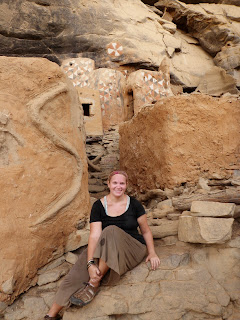 One of Marks good friends from his American days came and visited us in July. It was nice to finally meet someone from Marks past. Since we started dating in Mali we hadn’t had a chance to meet anyone from the others past. AJ was a great sport, his luggage was lost on arrival, it was over 110 degrees and the city of Bamako was as dusty as always. Luckily luggage was found and our trip to Dogan country was able to continue. Mark, AJ, one other friend Kendra and I all did a one night hike through Dogan again. We chose a different route this time (Mark and I hiked Dogan in 2010) and got to see different villages and different cliff faces. Dogan, as always is a scary thing for me. I’m not much of a hiker and those deadly latters and bridges don’t agree with me. But somehow I suck it up and get through it. And in the end it is all worth it. AJ, Mark and I also went to Djenne, a historical village near Marks village what houses the world’s largest structure (a mosque) made out of mud.
I closed my service (COS) as a Peace Corps volunteer on July 27, 2011. It was a moment of pure happiness and extreme sadness. It is always hard to leave some place you love and leave the people who became your family. As crappy as the situation was that I ended up in Mali I will always look back fondly of the places I went and the people I knew. And thankfully with the internet I am able to keep in contact with my work colleagues and host family.
After a clean bill of health I was off to Spain with Mark for a two week adventure there. I had never been to Spain and really didn’t know what to expect. We landed in Madrid and after finding our way to our first hotel we walked the streets of Madrid in Aww of the architecture, the people, the smells, and the sounds. We sat down at this little restaurant in the middle of a square (with a fountain!) and indulged on pork and sangria. I literally ate so much pork sausage I thought I was going to be sick, but it was so worth it! After we re-awoke from our food coma we went to a grocery store for the first time in three years! Imagine you haven’t had options in three years and then you see aisles and aisles of choices. You would freak out too. It took Mark and I almost two full hours to pick out one type of cheese, one sausage and a loaf of bread (you really can’t make this up, it is sadly true). We took a day trip to Segovia to see the aqueducts and the castle there and tried suckling pig. It sounds gross but let me tell you what, it was delicious, so tender and flavorful. The city was great too, but that pig was to die for. Back in Madrid we stayed with a friend of a friend who was amazing. He gave us free tickets into all of the national art museums and a behind the scenes tour of a Picasso painting being restored. The Spanish art museums were incredible. I never had an appreciation for Spanish art but I loved walking around the never ending halls of old and new art not to mention the galleries were air conditioned. All over Spain they have these great things called daily lunch specials where you get a starter, a main and a desert plus a glass of wine for around 8-10 Euros. It is entirely designed for tourist to try different local meals year round but boy of boy did I love that deal. So we tried all types of local traditional dishes all around Spain this way.
Madrid was amazing but sadly we had to keep moving, next we went to Granada in the south east of Spain. This place was fantastic. It was settled by the Moore’s (the same people who reside now in Morocco) so it is very Arab and different than northern Spain. The Moore’s have always been dessert people so imagine someone from the dessert having access to unlimited water supply, they went crazy! There were fountains every 5 feet, lush gardens covering every square inch of “old town”, reflecting pools in every house and did I mention the gardens? Also Granada is one of the last places in Spain to still give free tapas (appetizers) with each drink. Mark and I discovered this fantastic bar where you order a drink and a plate of food shows up… FOR FREE! We ordered a beer, a sandwich showed with a salad. We ordered another beer and a plate of pork and fries shows. We order another beer and another plate of something fantastic magically appears FOR FREE!!! I could have stayed there all night but sadly a long day of travel was in store for the next day so we had to call it an early night. We hopped around for a bit and then went to Santiago.
Santiago is famous in the catholic world for being a pilgrimage place where in olden days Catholics from all over Europe would pilgrim to kiss the neck of St James. We also stayed with someone just outside of Santiago. He was great and showed us all around western Spain. He took us to one of his local bars and had us enjoy octopus legs which were chewy but good. He also introduced us to these little green hot peppers that were lightly fried in olive oil and covered in coarse salt which was a favorite of mine while in Spain. We also got to meet some of his life long friends which was a real pleasure to meet a group of Spaniards who all spoke good English and we were able to chat for hours.
Sadly I fell terribly sick in Spain. I had a major reaction to an anti-malaria medication I had to take after leaving a malaria zone. I had a terrible fever, cold chills, total body aches and nausea I thought would kill me. I wanted to die but I pushed through and continued to France. Once mark and I got to France I was near death and had to go to the hospital to get blood work done. Doctors were afraid I had malaria so I got tested and it came back negative so I stopped taking that medication and eventually got better.
In France Mark and I were WWOOFing, that is the worldwide organization of organic farmers. We volunteer our time to work on someone’s farm and they give us free food and housing while we are there. I really wanted to find a farm that produced wine and cheese but apparently so did everyone else because all I could find was gardening work and apple picking, which was fine. Mark and I did two stents of two weeks each so our first two weeks were spent in Auteze, an extremely small village in the mountains near Carcassonne. Coming from West Africa I had spoken good west African French however that is very different from France French so that was the plan while volunteering, improve my French! I would say I was able to do this but maybe not to the extent that I wanted. The work in Auteze, like I said was gardening so we picked veggies, dug potatoes and onions and de-clovered a field. Mark surprised me for my 25th birthday early and bought cheese, wine and olives and took me to this great spot near a babbling mountain brook. We spent my real birthday in Carcassonne and walked the old walled city, ate more cheese and tried duck wings (which were tasty). It was a great birthday!
Our second farm was with a French family (speaking no English) on an apple orchard. I sorted apples by size and quality for two weeks while Mark picked apples off the trees. It was hard work but the family made up for that by preparing great traditional dishes like ratatouille, French onion soup and French toast. There, we worked hard and played hard. They had a pool and transport into the big city was easy so we had the entire afternoon to relax and goof off with the other volunteers and family.
After two weeks there I never wanted to see an apple and I will forever look at apples differently, always gauging them by size and quality. That was our last stop in France, so we had to go back to Spain and catch our cruise ship in Barcelona Spain. We took three days in Barcelona and enjoyed the Mediterranean beach, the Barcelona museums and La Ramble (the main shopping street with a huge daily market) and the Spanish wine and pork.
 We left Spain on the Disney Magic 2 week trans-Atlantic cruise ship. Mark had never been on a cruise and was delighted with the amenities and attractions on board. There were five ports of call and 8 glorious days of ocean sailing. The food, the shows, the gym, the pool, the sun, and the nice people we met on board made those sailing days fly by too quickly. You really can’t beat a two week cruise, across the Atlantic to travel back to America, not to mention it was cheaper than a flight! We docked in America on September 25 and I flew home for the first time in a year and two months.
To be home was amazing. I was greeted at the airport by mom, dad, Nick and his girlfriend Misty. They took me out to dinner where I enjoyed my first American meal of spicy chicken sandwich warp with fries and ranch dressing. Can’t get more American than that. I was able to see a lot of friends and family while home, but certainly not everyone. Most of my days were spent relaxing and starting a job hunt. Surprisingly I found a job less than two week after the day I started applying for jobs. I was hired on to a non-governmental organization called H.E.L.P. (Hope, Educate, Love & Protect) Malawi where Mark and I were both hired as International Program Managers. I left America exactly one month after arriving, back to Africa.
 As of late October I have been in Malawi, and it is great to have my best friend here with me. Mark and I have been able to travel around a little bit and are starting to enjoy life in Malawi. We have gone to the lake twice and enjoyed the crystal clear warm lake water.
Well, this was my 2011. Not too bad. I was in 13 countries this year, shared a beer with people from all over the world, spoke 4 languages to varying fluencies and had the time of my life. So here is to an amazing 2012!!
So first and foremost Merry Christmas to all of my friends and family and random people who read my blog, and thank you for doing so. So here is a re-cap of 2011.
 I rang in the New Year in Ghana with my boyfriend Mark and three other close friends. Accra, the capital of Ghana was extremely more developed than the capital of Guinea or Mali so we were all excited to have chines food and ice cream as our New Year’s Eve feast. Midnight was celebrated on a roof top bar, ducking and dodging ill exploding fireworks. New Year’s Day we went to the beach and enjoyed the warm Gulf of Guinea. Our two week vacation was over and a 48 hour bus ride back to Mali with a quick 16 hour stop in Burkina Faso to see some friends was our next adventure. Surprisingly after about the first 10 hours of the bus trip your mind shuts off and you just fall into a daze and block out everything bad about West African public transport and you get through it. We were welcomed back to Mali by some very friendly boarder customs agents around 6 in the morning on January 4th, 2011.
In February the town I was living in, Segou had its annual music festival which is internationally famous (if you are into West African music). The quant city I love changes over night into a huge party filled with Ex-patriots and West Africans alike. The quite streets are alive with beer sellers and avocado sandwich ladies. I hosted six people at my house where they slept on my roof because of lack of space inside. We experienced an out of the ordinary cold front that week and experienced temperatures as cold as 60 degrees at night. Brr! I got some great souvenirs and listened to some great African music.
In April a good friend of mine from college came and visited me for a week. Molly in Mali was the tag line of the week. She enjoyed seeing my life, meeting my friends, my Malian family and experiencing a normal day in village. She spent several days in my town and a few nights at Marks village. It was a real pleasure of mine to be able to show someone a bit of my life here.
May brought in the hot season where temperatures rise as high as 125+ for two solid months. It’s a bear! There is nothing you can do to avoid heat that high, especially when you don’t have air conditioning. The only good thing about this year’s hot season was it wasn’t as bad as 2010’s hot season here temperatures were over 130 for three months.
 One of Marks good friends from his American days came and visited us in July. It was nice to finally meet someone from Marks past. Since we started dating in Mali we hadn’t had a chance to meet anyone from the others past. AJ was a great sport, his luggage was lost on arrival, it was over 110 degrees and the city of Bamako was as dusty as always. Luckily luggage was found and our trip to Dogan country was able to continue. Mark, AJ, one other friend Kendra and I all did a one night hike through Dogan again. We chose a different route this time (Mark and I hiked Dogan in 2010) and got to see different villages and different cliff faces. Dogan, as always is a scary thing for me. I’m not much of a hiker and those deadly latters and bridges don’t agree with me. But somehow I suck it up and get through it. And in the end it is all worth it. AJ, Mark and I also went to Djenne, a historical village near Marks village what houses the world’s largest structure (a mosque) made out of mud.
I closed my service (COS) as a Peace Corps volunteer on July 27, 2011. It was a moment of pure happiness and extreme sadness. It is always hard to leave some place you love and leave the people who became your family. As crappy as the situation was that I ended up in Mali I will always look back fondly of the places I went and the people I knew. And thankfully with the internet I am able to keep in contact with my work colleagues and host family.
After a clean bill of health I was off to Spain with Mark for a two week adventure there. I had never been to Spain and really didn’t know what to expect. We landed in Madrid and after finding our way to our first hotel we walked the streets of Madrid in Aww of the architecture, the people, the smells, and the sounds. We sat down at this little restaurant in the middle of a square (with a fountain!) and indulged on pork and sangria. I literally ate so much pork sausage I thought I was going to be sick, but it was so worth it! After we re-awoke from our food coma we went to a grocery store for the first time in three years! Imagine you haven’t had options in three years and then you see aisles and aisles of choices. You would freak out too. It took Mark and I almost two full hours to pick out one type of cheese, one sausage and a loaf of bread (you really can’t make this up, it is sadly true). We took a day trip to Segovia to see the aqueducts and the castle there and tried suckling pig. It sounds gross but let me tell you what, it was delicious, so tender and flavorful. The city was great too, but that pig was to die for. Back in Madrid we stayed with a friend of a friend who was amazing. He gave us free tickets into all of the national art museums and a behind the scenes tour of a Picasso painting being restored. The Spanish art museums were incredible. I never had an appreciation for Spanish art but I loved walking around the never ending halls of old and new art not to mention the galleries were air conditioned. All over Spain they have these great things called daily lunch specials where you get a starter, a main and a desert plus a glass of wine for around 8-10 Euros. It is entirely designed for tourist to try different local meals year round but boy of boy did I love that deal. So we tried all types of local traditional dishes all around Spain this way.
Madrid was amazing but sadly we had to keep moving, next we went to Granada in the south east of Spain. This place was fantastic. It was settled by the Moore’s (the same people who reside now in Morocco) so it is very Arab and different than northern Spain. The Moore’s have always been dessert people so imagine someone from the dessert having access to unlimited water supply, they went crazy! There were fountains every 5 feet, lush gardens covering every square inch of “old town”, reflecting pools in every house and did I mention the gardens? Also Granada is one of the last places in Spain to still give free tapas (appetizers) with each drink. Mark and I discovered this fantastic bar where you order a drink and a plate of food shows up… FOR FREE! We ordered a beer, a sandwich showed with a salad. We ordered another beer and a plate of pork and fries shows. We order another beer and another plate of something fantastic magically appears FOR FREE!!! I could have stayed there all night but sadly a long day of travel was in store for the next day so we had to call it an early night. We hopped around for a bit and then went to Santiago.
Santiago is famous in the catholic world for being a pilgrimage place where in olden days Catholics from all over Europe would pilgrim to kiss the neck of St James. We also stayed with someone just outside of Santiago. He was great and showed us all around western Spain. He took us to one of his local bars and had us enjoy octopus legs which were chewy but good. He also introduced us to these little green hot peppers that were lightly fried in olive oil and covered in coarse salt which was a favorite of mine while in Spain. We also got to meet some of his life long friends which was a real pleasure to meet a group of Spaniards who all spoke good English and we were able to chat for hours.
Sadly I fell terribly sick in Spain. I had a major reaction to an anti-malaria medication I had to take after leaving a malaria zone. I had a terrible fever, cold chills, total body aches and nausea I thought would kill me. I wanted to die but I pushed through and continued to France. Once mark and I got to France I was near death and had to go to the hospital to get blood work done. Doctors were afraid I had malaria so I got tested and it came back negative so I stopped taking that medication and eventually got better.
In France Mark and I were WWOOFing, that is the worldwide organization of organic farmers. We volunteer our time to work on someone’s farm and they give us free food and housing while we are there. I really wanted to find a farm that produced wine and cheese but apparently so did everyone else because all I could find was gardening work and apple picking, which was fine. Mark and I did two stents of two weeks each so our first two weeks were spent in Auteze, an extremely small village in the mountains near Carcassonne. Coming from West Africa I had spoken good west African French however that is very different from France French so that was the plan while volunteering, improve my French! I would say I was able to do this but maybe not to the extent that I wanted. The work in Auteze, like I said was gardening so we picked veggies, dug potatoes and onions and de-clovered a field. Mark surprised me for my 25th birthday early and bought cheese, wine and olives and took me to this great spot near a babbling mountain brook. We spent my real birthday in Carcassonne and walked the old walled city, ate more cheese and tried duck wings (which were tasty). It was a great birthday!
Our second farm was with a French family (speaking no English) on an apple orchard. I sorted apples by size and quality for two weeks while Mark picked apples off the trees. It was hard work but the family made up for that by preparing great traditional dishes like ratatouille, French onion soup and French toast. There, we worked hard and played hard. They had a pool and transport into the big city was easy so we had the entire afternoon to relax and goof off with the other volunteers and family.
After two weeks there I never wanted to see an apple and I will forever look at apples differently, always gauging them by size and quality. That was our last stop in France, so we had to go back to Spain and catch our cruise ship in Barcelona Spain. We took three days in Barcelona and enjoyed the Mediterranean beach, the Barcelona museums and La Ramble (the main shopping street with a huge daily market) and the Spanish wine and pork.
 We left Spain on the Disney Magic 2 week trans-Atlantic cruise ship. Mark had never been on a cruise and was delighted with the amenities and attractions on board. There were five ports of call and 8 glorious days of ocean sailing. The food, the shows, the gym, the pool, the sun, and the nice people we met on board made those sailing days fly by too quickly. You really can’t beat a two week cruise, across the Atlantic to travel back to America, not to mention it was cheaper than a flight! We docked in America on September 25 and I flew home for the first time in a year and two months.
To be home was amazing. I was greeted at the airport by mom, dad, Nick and his girlfriend Misty. They took me out to dinner where I enjoyed my first American meal of spicy chicken sandwich warp with fries and ranch dressing. Can’t get more American than that. I was able to see a lot of friends and family while home, but certainly not everyone. Most of my days were spent relaxing and starting a job hunt. Surprisingly I found a job less than two week after the day I started applying for jobs. I was hired on to a non-governmental organization called H.E.L.P. (Hope, Educate, Love & Protect) Malawi where Mark and I were both hired as International Program Managers. I left America exactly one month after arriving, back to Africa.
 As of late October I have been in Malawi, and it is great to have my best friend here with me. Mark and I have been able to travel around a little bit and are starting to enjoy life in Malawi. We have gone to the lake twice and enjoyed the crystal clear warm lake water.
Well, this was my 2011. Not too bad. I was in 13 countries this year, shared a beer with people from all over the world, spoke 4 languages to varying fluencies and had the time of my life. So here is to an amazing 2012!!
Friday, November 25, 2011
The holiday season away from home, again
This is my third consecutive thanksgiving away from home, and going on my fourth Christmas away from home. There are many things that I enjoy about living abroad, however the holidays are not one of them.
You have to learn how to make traditional traditions and different family traditions into a special day. Holidays need to be celebrated. They are major mile stone in the year. It would be easy while away to not celebrate the Fourth of July or Thanksgiving, but I need to celebrate those to bring more stability and familiarity to my life away from home.
This year for thanksgiving I will be spending Saturday with several other Americans, trying to make a traditional thanksgiving feast. Instead of turkey however we are doing chickens, there will be mashed potatoes, green beans, cooked carrots and hopefully if we are lucky pumpkin pie. It wont be the same as sitting around Aunt Betty’s table but I will still be with good people, sharing good food and giving thanks for the things I have.
You have to learn how to make traditional traditions and different family traditions into a special day. Holidays need to be celebrated. They are major mile stone in the year. It would be easy while away to not celebrate the Fourth of July or Thanksgiving, but I need to celebrate those to bring more stability and familiarity to my life away from home.
This year for thanksgiving I will be spending Saturday with several other Americans, trying to make a traditional thanksgiving feast. Instead of turkey however we are doing chickens, there will be mashed potatoes, green beans, cooked carrots and hopefully if we are lucky pumpkin pie. It wont be the same as sitting around Aunt Betty’s table but I will still be with good people, sharing good food and giving thanks for the things I have.
Friday, November 18, 2011
Lake Malawi
Malawi is known as the “Warm heart of Africa.” It seems as though everyone you meet is excited about life and willing to open their heart and home to you. There are many things to do and see in Malawi, I however have only been here a short while and have seen very little but something I am glad I did early in my stay here was go to Lake Malawi.

Lake Malawi is one of the largest fresh water lakes in Africa. It provides fresh fish for thousands of people who are fighting protein deficiencies; it is also a major tourist destination. I went to a lake side sleepy village called Cape Mclear which is on the cusp of the national forest and the lake.
Inside the national forest there is an amazing place called otters point which is a secluded section of the lake that has a rocky/boulder shore line. Mark and I met with some of our friends and colleagues there and spent the afternoon in the water, swimming among the fish and jumping off the rocks. It was a grand time. We also taught Able, the head teacher of Nanthomba primary school (the school I work with) how to swim.

All in all it was a fantastic day and a good get a way.
Wednesday, November 16, 2011
First day of work
It has been about three weeks here in Malawi now. As in all jobs the first few weeks are difficult, learning the ropes, finding your way around, and memorizing everyone’s names can all prove to be very overwhelming; but I’m starting to settle in, find a routine and make new friends.
My first day on the job in country I got a tour of the school I will be working at, met all of the teachers and played around with some of the students, or as they say here, learners. Next I got a tour of a fantastic health center with maternity ward 4 Km up the road the HELP has helped to build. I met Frank and Impatso, the local nurse and midwife. They showed me the vegetable garden they want to use as a nutritional showcase for malnourished children and mothers, and I even saw a first time mother, hours after delivery holding her first born baby son.
As the day was wrapping down I got to take a real “out of the Lion King” style safari. A group of us jumped into a safari vehicle and our amazing guide, Henry showed us several groups of elephants, including baby elephants, warthogs (little known fact, baby warthogs are the cutest thing in the world), bushback, impala, monkeys, baboons, and tons of other animals. Just as the sun was setting we parked our car, jumped down and shared an ice cold beer and popcorn watching the sun set over the mountains down river.
When we got back to camp we had a delicious dinner while overlooking the Shire River listening to the hippos in the distance. I must say, that was the best first day of work I have ever had!
My first day on the job in country I got a tour of the school I will be working at, met all of the teachers and played around with some of the students, or as they say here, learners. Next I got a tour of a fantastic health center with maternity ward 4 Km up the road the HELP has helped to build. I met Frank and Impatso, the local nurse and midwife. They showed me the vegetable garden they want to use as a nutritional showcase for malnourished children and mothers, and I even saw a first time mother, hours after delivery holding her first born baby son.
As the day was wrapping down I got to take a real “out of the Lion King” style safari. A group of us jumped into a safari vehicle and our amazing guide, Henry showed us several groups of elephants, including baby elephants, warthogs (little known fact, baby warthogs are the cutest thing in the world), bushback, impala, monkeys, baboons, and tons of other animals. Just as the sun was setting we parked our car, jumped down and shared an ice cold beer and popcorn watching the sun set over the mountains down river.
When we got back to camp we had a delicious dinner while overlooking the Shire River listening to the hippos in the distance. I must say, that was the best first day of work I have ever had!
Tuesday, October 25, 2011
An update of my life
As you all know I left Mali back in July, spent two amazing months traveling around Spain and France, took a transatlantic cruise back to America and then spent some time with my family.
To start things off, I had never been to Spain before and found it incredible. The people were amazing, the food was delicious and the sangria was to die for. Not to mention the Spanish culture, the flamenco dances and the public gardens. Mark and I spent two weeks bouncing around with visiting friends in Madrid, Granada, Santiago, and Barcelona. In Madrid we got a private behind the scene tour of the restoration room in the La Rein Sofia Museum where we got to see people restoring a Picasso, we toured the royal gardens and walked the city. In Granada we went to a walled royal city where there were lush gardens and fish ponds everywhere. It was such a contrast after living 2 years in the desert to see all the colorful flowers and fountains everywhere. In Santiago we did the last mile of a 1000 year old pilgrimage (El Camino) to the Saint James Cathedral in Santiago.
After Santiago Spain we went to France to start our World Wide Opportunities on Organic Farm (WWOOF-ing) projects. First we went to a small farm in Auteze where we were working with an older woman helping her with her garden. I pulled a ton of weeds, picked tomato’s, picked potatoes right out of the ground with my hands and also prepared for market day. It wasn’t the best two weeks of my life, but the work wasn’t that hard and the mountains were pretty. Then we went to Thuir and worked on an apple orchard. I would sort apples while Mark picked them. This was hard work and I would be content never seeing another apple again in my life. That being said, the people who ran the farm were so nice and it was a great opportunity to brush up on my France French as opposed to my West African French.
After our month if France Mark and I headed down to Barcelona and spent two days touring and hanging out on the Mediterranean beaches before we jumped on our Disney Transatlantic cruise. I must admit that I was a little nervous to spend 14 days on a boat with crazy Disney fanatics but it wasn’t that bad. There were plenty of Disney crazy’s but the majority of people were normal I’d say. We spent in total 8 days at sea and then stopped in Gibraltar, Madera, St Marten, Tortola, and Disney’s private island Castaway Cay. My favorite stop had to be Gibraltar because we rode a cable car up the rock and walked down stopping at ape caves along the way.
Once I got home from the cruise I started looking for work. I sent out probably close to 75 resumes and within a week I got an interview and two weeks later I was hired. I took a job with HELP Malawi and will be heading back to Africa for another two year paid contract working as a program manager. I’m writing this from the airport so once I got to Malawi I’ll blog again letting everyone know I’m alive and well. I’m also excited to show off my new lodging arrangements. I will be living at a safari lodge right on a river where I’ll hopefully be able to see wild animals from time to time. But if you want to know more go to http://helpchildren.org/
To start things off, I had never been to Spain before and found it incredible. The people were amazing, the food was delicious and the sangria was to die for. Not to mention the Spanish culture, the flamenco dances and the public gardens. Mark and I spent two weeks bouncing around with visiting friends in Madrid, Granada, Santiago, and Barcelona. In Madrid we got a private behind the scene tour of the restoration room in the La Rein Sofia Museum where we got to see people restoring a Picasso, we toured the royal gardens and walked the city. In Granada we went to a walled royal city where there were lush gardens and fish ponds everywhere. It was such a contrast after living 2 years in the desert to see all the colorful flowers and fountains everywhere. In Santiago we did the last mile of a 1000 year old pilgrimage (El Camino) to the Saint James Cathedral in Santiago.
After Santiago Spain we went to France to start our World Wide Opportunities on Organic Farm (WWOOF-ing) projects. First we went to a small farm in Auteze where we were working with an older woman helping her with her garden. I pulled a ton of weeds, picked tomato’s, picked potatoes right out of the ground with my hands and also prepared for market day. It wasn’t the best two weeks of my life, but the work wasn’t that hard and the mountains were pretty. Then we went to Thuir and worked on an apple orchard. I would sort apples while Mark picked them. This was hard work and I would be content never seeing another apple again in my life. That being said, the people who ran the farm were so nice and it was a great opportunity to brush up on my France French as opposed to my West African French.
After our month if France Mark and I headed down to Barcelona and spent two days touring and hanging out on the Mediterranean beaches before we jumped on our Disney Transatlantic cruise. I must admit that I was a little nervous to spend 14 days on a boat with crazy Disney fanatics but it wasn’t that bad. There were plenty of Disney crazy’s but the majority of people were normal I’d say. We spent in total 8 days at sea and then stopped in Gibraltar, Madera, St Marten, Tortola, and Disney’s private island Castaway Cay. My favorite stop had to be Gibraltar because we rode a cable car up the rock and walked down stopping at ape caves along the way.
Once I got home from the cruise I started looking for work. I sent out probably close to 75 resumes and within a week I got an interview and two weeks later I was hired. I took a job with HELP Malawi and will be heading back to Africa for another two year paid contract working as a program manager. I’m writing this from the airport so once I got to Malawi I’ll blog again letting everyone know I’m alive and well. I’m also excited to show off my new lodging arrangements. I will be living at a safari lodge right on a river where I’ll hopefully be able to see wild animals from time to time. But if you want to know more go to http://helpchildren.org/
Saturday, February 12, 2011
Ghana Christmas Vacation
In December two friends and I set off for our Christmas Vacation in Ghana, a two day trip on the coast of the Gulf of Guinea. We were lucky and got a direct bus from Bamako to Kumasi, Ghana which took 44 hours.
Kumasi hosts West Africa’s largest open air market and it was in full Christmas shopping swing when we arrived. Ghana is almost 50% Christian and 50% Muslim and with the larger disposable income of the country the market was swelled with people. It was amazing to see blenders, X-Box, iPods, and laptops on Christmas special where in Mali most of those things are inaccessible to most of the population.

We also visited several slave castles along the coast, including the two largest slave trade castles in West Africa. The historical significance of visiting these places, having local Ghanaian’s as tour guides explaining the savage history of their land will be something that I will remember for the rest of my life.

On a lighter note, we also meet up with two other friends from Mali and took the aerial walk outside of Cape Coast. Towards the coast of Ghana is rainforest and in the Kukuma National Park they have constructed a walkway bridge between eight trees stretching more than 400 meters into the air. You could feel the rope bridge swinging in the air and at parts you couldn’t even see the ground threw the trees below us.

Ghana also has some amazing coast lines. For Christmas we spent three days at a “Green Resort” on a secluded beach. We passed the days in the water and the nights around bon-fires on the white sand beaches. However, sadly all vacations must come to an end and this trip was no different.
Kumasi hosts West Africa’s largest open air market and it was in full Christmas shopping swing when we arrived. Ghana is almost 50% Christian and 50% Muslim and with the larger disposable income of the country the market was swelled with people. It was amazing to see blenders, X-Box, iPods, and laptops on Christmas special where in Mali most of those things are inaccessible to most of the population.

We also visited several slave castles along the coast, including the two largest slave trade castles in West Africa. The historical significance of visiting these places, having local Ghanaian’s as tour guides explaining the savage history of their land will be something that I will remember for the rest of my life.

On a lighter note, we also meet up with two other friends from Mali and took the aerial walk outside of Cape Coast. Towards the coast of Ghana is rainforest and in the Kukuma National Park they have constructed a walkway bridge between eight trees stretching more than 400 meters into the air. You could feel the rope bridge swinging in the air and at parts you couldn’t even see the ground threw the trees below us.

Ghana also has some amazing coast lines. For Christmas we spent three days at a “Green Resort” on a secluded beach. We passed the days in the water and the nights around bon-fires on the white sand beaches. However, sadly all vacations must come to an end and this trip was no different.
Women in village vs. city
I recently read the book Monique and the Mango Rains about a Peace Corps volunteer in the 80’s stationed in Mali writing about her experience. The book focused on women’s rights and Malian culture. I thought I could give a brief profile of two different women that I have worked with during my service
Fatamata Sydibe
Fatamata (age 26) grew up in Segou Mali and went to high school up to grade 10 then dropped out to get married off at age 17. She is the first wife of her husband and she has three children under the age of eight. She works as a secretary at Miselini (my work) from 9-4 Monday threw Friday, and because she has a one year old child she gets an hour off every morning to breast feed. She wakes at 5am to start making the morning porridge and because her house servants left her she and her mother take turns preparing the daily meals in the morning before work. On Saturday it is laundry day where she washes by hand the family laundry for the week, which is no small task. She owns her own moto that she has worked hard to afford and the majority of her money goes to her husband who makes all of the monetary decisions for the family. From her salary her husband gives her an allowance for herself that she purchases her cloths. She is in charge of food shopping every week and rationing the food amongst the family.
Aminata Berry
Aminata (age 52) grew up in a small town in Guinea. She was one of 15 siblings and was the top female student in her class up until grade 5 where she was forced to drop out so her younger brothers could go to school and she would have to take care of the house. She was married by 14 years old and soon started having a family. Her husband moved around and married three other wives. When Aminata’s first son started going to school, she would take his text books at night and teach herself math, French and even English when they lived in Ghana. She ended up settling in Doune Guinea, and was working as the town mid-wife, activist against women’s genital mutilation (excision), president of the women’s group, village pharmacist, hospital nurse, village chef and host. She was living on top of a hill and was often seen carrying heavy buckets of water for her family. Due to her busy schedule she often got to skip making family meals and one of the other three wives would prepare while she was off working. She received very little money for any of her work and all of her money went straight to construction of her own house. After 40 years of living with a man she never loved she was moving out, something unheard of in village. She saved her own money and on the outskirts of town was building her own three bedroom house. She was also taking moto lessons; in Guinea it is almost unheard of for women to drive a moto. She was the president of the group I worked with and was by far the most influential person I had ever met.
Both of these women have a lot in common however they are very rare exceptions. In village it isn’t unheard of for women to never leave their compound with no contact with people other than their family.
Also women are in charge of all cooking, cleaning, fetching water, field work, raising children, selling in market and buying in market. All of those things are done by hand year round. Now I am not advocating polygamy but it is easy to see when there are several wives that the work gets split and life does become much easier.
Fatamata Sydibe
Fatamata (age 26) grew up in Segou Mali and went to high school up to grade 10 then dropped out to get married off at age 17. She is the first wife of her husband and she has three children under the age of eight. She works as a secretary at Miselini (my work) from 9-4 Monday threw Friday, and because she has a one year old child she gets an hour off every morning to breast feed. She wakes at 5am to start making the morning porridge and because her house servants left her she and her mother take turns preparing the daily meals in the morning before work. On Saturday it is laundry day where she washes by hand the family laundry for the week, which is no small task. She owns her own moto that she has worked hard to afford and the majority of her money goes to her husband who makes all of the monetary decisions for the family. From her salary her husband gives her an allowance for herself that she purchases her cloths. She is in charge of food shopping every week and rationing the food amongst the family.
Aminata Berry
Aminata (age 52) grew up in a small town in Guinea. She was one of 15 siblings and was the top female student in her class up until grade 5 where she was forced to drop out so her younger brothers could go to school and she would have to take care of the house. She was married by 14 years old and soon started having a family. Her husband moved around and married three other wives. When Aminata’s first son started going to school, she would take his text books at night and teach herself math, French and even English when they lived in Ghana. She ended up settling in Doune Guinea, and was working as the town mid-wife, activist against women’s genital mutilation (excision), president of the women’s group, village pharmacist, hospital nurse, village chef and host. She was living on top of a hill and was often seen carrying heavy buckets of water for her family. Due to her busy schedule she often got to skip making family meals and one of the other three wives would prepare while she was off working. She received very little money for any of her work and all of her money went straight to construction of her own house. After 40 years of living with a man she never loved she was moving out, something unheard of in village. She saved her own money and on the outskirts of town was building her own three bedroom house. She was also taking moto lessons; in Guinea it is almost unheard of for women to drive a moto. She was the president of the group I worked with and was by far the most influential person I had ever met.
Both of these women have a lot in common however they are very rare exceptions. In village it isn’t unheard of for women to never leave their compound with no contact with people other than their family.
Also women are in charge of all cooking, cleaning, fetching water, field work, raising children, selling in market and buying in market. All of those things are done by hand year round. Now I am not advocating polygamy but it is easy to see when there are several wives that the work gets split and life does become much easier.
Getting Braided
As hot season approaches I recently got my hair braided again. I have a serious love/hate relationship with getting my hair braided for several reasons.
On the side of LOVE:
-Every woman Malian has her hair braided from the moment the hair is long enough to braid
-It is much cooler
-It gives me a reason not to wash it
-I don’t have to fuss with it
On the side of HATE:
-Malian women don’t know how to braid white hair
-Sunburns!
-It takes forever to braid and even longer to take out
-My hair is so long it tangles inside of the braids
-It pulls a lot of my hair out and makes it more fragile
However despite all that, I went to a baptism and had my hair braided for it. Two girls came over in the morning and started to pull at my hair. After about five rows, my eyes are watering and they ask me if my hair is extentions because it has the feel of mesh. That is never a good sign, which means they are having a hard time braiding my hair in rows. Almost an hour later they were finishing up and all three of us were ready to finish.
All said and done, it looked ok and after two days the pulling pain went away.


On the side of LOVE:
-Every woman Malian has her hair braided from the moment the hair is long enough to braid
-It is much cooler
-It gives me a reason not to wash it
-I don’t have to fuss with it
On the side of HATE:
-Malian women don’t know how to braid white hair
-Sunburns!
-It takes forever to braid and even longer to take out
-My hair is so long it tangles inside of the braids
-It pulls a lot of my hair out and makes it more fragile
However despite all that, I went to a baptism and had my hair braided for it. Two girls came over in the morning and started to pull at my hair. After about five rows, my eyes are watering and they ask me if my hair is extentions because it has the feel of mesh. That is never a good sign, which means they are having a hard time braiding my hair in rows. Almost an hour later they were finishing up and all three of us were ready to finish.
All said and done, it looked ok and after two days the pulling pain went away.


Meeting Etiquette
Once a quarter my micro-finance organization has a meeting with five women who have been elected to represent the voice of our loan clients. These are most likely the loudest five women in Segou.
Our meeting was supposed to start at two pm on a Friday. I biked back to work after lunch to find the office locked up still from Friday prayer. So a boutique owner lent me a chair and some shade and I waited for half an hour for my bosses to show up and let me inside. Once inside it was almost three, and there was no sign of these five women anywhere. Normal work hours are 8am to 4pm here so when I saw it was past three and still no women I thought the meeting would just be canceled.
Two women show up around 3:30, so my boss and I start the meeting. Because the women don’t speak French, my boss was in charge of running the meeting and I was just to sit there and wait for translation. Over time more women show up and the meeting keeps getting repeated to catch the late comers up.
At one point all five ladies were screaming their heads off and my boss was screaming back at them. Because it was in bambara I still had no idea what was going on so I just sat there in awe of the argument. I mentioned earlier that these were the five loudest women in Segou, well the room was almost vibrating from the commotion. And by that time it was pushing 6pm… on a Friday. All of a sudden everyone sat down very calmly and said its over and the women left. I looked at my boss and asked what happened and he just shook his head and said they were talking about bread prices.
Our meeting was supposed to start at two pm on a Friday. I biked back to work after lunch to find the office locked up still from Friday prayer. So a boutique owner lent me a chair and some shade and I waited for half an hour for my bosses to show up and let me inside. Once inside it was almost three, and there was no sign of these five women anywhere. Normal work hours are 8am to 4pm here so when I saw it was past three and still no women I thought the meeting would just be canceled.
Two women show up around 3:30, so my boss and I start the meeting. Because the women don’t speak French, my boss was in charge of running the meeting and I was just to sit there and wait for translation. Over time more women show up and the meeting keeps getting repeated to catch the late comers up.
At one point all five ladies were screaming their heads off and my boss was screaming back at them. Because it was in bambara I still had no idea what was going on so I just sat there in awe of the argument. I mentioned earlier that these were the five loudest women in Segou, well the room was almost vibrating from the commotion. And by that time it was pushing 6pm… on a Friday. All of a sudden everyone sat down very calmly and said its over and the women left. I looked at my boss and asked what happened and he just shook his head and said they were talking about bread prices.
Friday, December 10, 2010
Tabaski 2010
Tabaski is the Muslim holiday that celebrates the willingness of Abraham to sacrifice his son to God, then at the last second God presented a ram instead to sacrifice.

In Mali they sacrifice sheep or goat after the morning prayer. I went to Marks village this year for the celebration. Early in the morning we got dressed up in our matching Malian outfits to go to the prayer in the open field in town. The men were able to pray in the shade while the women were in the direct sunlight.

After the prayers were over, Mark and I followed the parade of people leaving the prayer and marching threw village singing religious songs to the mosque in the center of town.

When we made it to the mosque we found out that Marks co-worker was the one in charge of leading the prayers which is a very respectable job.
Once all the prayers were done, it was time to kill the goat. I had no part in the killings or the cooking for that matter which is how i preferred it. It is not pretty work killing and cleaning a goat. However it sure was tasty. I ate so much meat, which is a luxury.
This was my first traditional village tabaski since i've been in Africa so i was happy i was able to share this experience in Marks village with his friends and mine.

In Mali they sacrifice sheep or goat after the morning prayer. I went to Marks village this year for the celebration. Early in the morning we got dressed up in our matching Malian outfits to go to the prayer in the open field in town. The men were able to pray in the shade while the women were in the direct sunlight.


After the prayers were over, Mark and I followed the parade of people leaving the prayer and marching threw village singing religious songs to the mosque in the center of town.

When we made it to the mosque we found out that Marks co-worker was the one in charge of leading the prayers which is a very respectable job.
Once all the prayers were done, it was time to kill the goat. I had no part in the killings or the cooking for that matter which is how i preferred it. It is not pretty work killing and cleaning a goat. However it sure was tasty. I ate so much meat, which is a luxury.
This was my first traditional village tabaski since i've been in Africa so i was happy i was able to share this experience in Marks village with his friends and mine.
Two years, Two countries
December 6th marked my two years in Africa. It is so hard to believe that two years ago I was setting off into an un-known world, not knowing what to expect. And its even more unbelievable how fast I adapted to life in Guinea.
When I set off for my two years in the Peace Corps i was sent to a small village where i didn't know the language, didn't understand the customs and cultures, didn't know where to turn or how to make a phone call. I even had to re-learn to eat. Everything about my life in Guinea i had to learn from the beginning. The first meal I shared with my host family, there was no spoon. I had to reach my hand into a hot bowl of rice and try to make a ball of rice and my hand fit into my mouth. I spilled rice all over myself. With each falling grain of rice I couldn't help but think, I’m spilling these peoples livelihood all over my lap. Sedda Sedda (small small) my Pular came along. I remember the first day I could go to a market and order all of my food in Pular. It was such a success to be able to have a conversation, no matter the content in the local language, and the first time I had to pull water from the well and thought I would loose my glasses down the well. I also remember the day that the children by my house stopped calling me Porto (outsider or white) and started calling me by my Guinean name, Oumou Kesso Barry. There were many days where I spent hanging out with a group of 7th graders under an avocado tree. I looked forward to my afternoon tea time with those kids everyday. I felt included and looked after hanging out with them. Despite the fact that we had nothing in common they were some of my best friends.
I also had to learn to be away from my family and how to build a new family. At first especially i had a hard time being away from everyone and everything i knew. I didn't have access to phones or internet and letters and packages only came once a month bringing special treats from loved ones. I had to accept my host family as my new family. The children helped me with everything and looked up to me like a big sister.
I was also able to share my experiences with the village. I helped at the village health center, weighing babies and encouraging mothers to feed their children more so they can become healthier and stronger. I shared information about hand washing and ways to prevent Malaria. I taught an English class where I encouraged students to continue with their education so they too can one day make a difference. I worked with a women’s group trying to promote the rights of women and helped them find some financial independence from their husbands. I worked on a polio campaign to give free vaccinations to children and inform families to the benefits of western medicine.
While doing all of those things I was fighting off sickness and political unrest. In my year in Guinea I had been so sick many different times. There are different standards of clean and sicknesses run wild. When I first arrived in Guinea the president Conate died leaving the presidential seat wanted by all. There was a bloodless coup d'etat that followed with military enforced curfews. It became very common to see AK-47's and traveling around the country became more difficult and dangerous.
In September 2009 the military open fired on a stadium of unarmed peaceful protesters. 157 reported dead and the capital city, Conakry was not the same. It became too hard to keep volunteers in Guinea and we were evacuated to Bamako, Mali.
After a month of limbo, the Guinea program was closed leaving 97 volunteers heartbroken and homeless. We had the choice to transfer countries, close our service or take a leave and wait for guinea to re-open. I ended up transferring to Mali because I felt that my service was incomplete and I would be able to experience a new place. There with nine other Guinea volunteers that transferred with me to Mali and could help share the feelings of having to start lost and out of place all over.
My new home in Mali is in Segou, a large regional capital with all of the amenities of a large African city. I was happy to accept a house with running water, electricity and I even have internet access everyday at the Peace Corps house.
My transition into Malian life was cushioned by the amenities but I still miss my Guinea village and think of them often. My lifestyle between my village in Guinea and my life in Segou is almost incomparable. In Segou, I live alone inside a family compound and have very little interaction with them. I go to work every morning and socialize with Americans on a daily basis. Also, I started dating Mark in December and have enjoyed splitting my time between his village and my city. This has allowed me to have the village interactions I was missing from Guinea and Mark and I can share the hardship of being ripped from one country and installed in another since he was one of the nine that came from guinea.
I have spent the last year working specifically with a micro-finance institution called Miselini. I set up a marketing campaign so they could reach out and grow their clientele however hit a wall after giving out 12.000.000 CFA or $60,000 to 24 women’s groups and had to turn down women who needed credit to grow their business and help their family. I worked along side the president of Miselini to apply for a partnership between Miselini and Kiva International. I felt that Kiva would be a good fit because it is a no-interest loan from American’s. Please check out the Kiva website to find out more ways that you can change lives. http://www.kiva.org/
Over the last two years I have learned to make Africa my home. I have been exposed to so many new cultures and customs that I would never have been able to understand from America. I have meet some of the poorest people in the world and been able to break bread with them and travel to some of the most naturally beautiful places. I will never take for granted running water again. The project I am working on will not be done by my original COS date, therefore I just submitted my extension until August 2011. I am looking forward to the next nine months that I have left in Mali despite the hot season where temperatures can raise over 120 degrees.
I would like to specifically thank certain family members that have sent me countless packages that help keep me sane and full of tasty American food.
-Mom and Dad: almost every month I get at least one package from you with things that keep me in touch with America and with what is going on with the family while I’m away.
-Aunt Betty and Uncle Dan and all the Curley’s: I don’t even know how to thank you for all of the food you have sent me. You have made me very popular among the volunteers when I share my food with them. And all of those jelly beans were devoured by my work and Marks village.
-Grandma: I love the letters you send on a regular basis. I know I’m not good at sitting down and writing you back but I enjoy reading what you are up to and whenever you send the grandma crackers or homemade cookies its like I had just been to your house in Tennessee.
-Uncle Tim: I love the music, books and brownies you send
-Aunt Bonnie, Uncle Wes, and Kyle: Thanks so much for everything you send
And a huge thank you to everyone else who has sent me cards, letters and packages. I know how expensive things are to send here and I truly appreciate everything.
When I set off for my two years in the Peace Corps i was sent to a small village where i didn't know the language, didn't understand the customs and cultures, didn't know where to turn or how to make a phone call. I even had to re-learn to eat. Everything about my life in Guinea i had to learn from the beginning. The first meal I shared with my host family, there was no spoon. I had to reach my hand into a hot bowl of rice and try to make a ball of rice and my hand fit into my mouth. I spilled rice all over myself. With each falling grain of rice I couldn't help but think, I’m spilling these peoples livelihood all over my lap. Sedda Sedda (small small) my Pular came along. I remember the first day I could go to a market and order all of my food in Pular. It was such a success to be able to have a conversation, no matter the content in the local language, and the first time I had to pull water from the well and thought I would loose my glasses down the well. I also remember the day that the children by my house stopped calling me Porto (outsider or white) and started calling me by my Guinean name, Oumou Kesso Barry. There were many days where I spent hanging out with a group of 7th graders under an avocado tree. I looked forward to my afternoon tea time with those kids everyday. I felt included and looked after hanging out with them. Despite the fact that we had nothing in common they were some of my best friends.
I also had to learn to be away from my family and how to build a new family. At first especially i had a hard time being away from everyone and everything i knew. I didn't have access to phones or internet and letters and packages only came once a month bringing special treats from loved ones. I had to accept my host family as my new family. The children helped me with everything and looked up to me like a big sister.
I was also able to share my experiences with the village. I helped at the village health center, weighing babies and encouraging mothers to feed their children more so they can become healthier and stronger. I shared information about hand washing and ways to prevent Malaria. I taught an English class where I encouraged students to continue with their education so they too can one day make a difference. I worked with a women’s group trying to promote the rights of women and helped them find some financial independence from their husbands. I worked on a polio campaign to give free vaccinations to children and inform families to the benefits of western medicine.
While doing all of those things I was fighting off sickness and political unrest. In my year in Guinea I had been so sick many different times. There are different standards of clean and sicknesses run wild. When I first arrived in Guinea the president Conate died leaving the presidential seat wanted by all. There was a bloodless coup d'etat that followed with military enforced curfews. It became very common to see AK-47's and traveling around the country became more difficult and dangerous.
In September 2009 the military open fired on a stadium of unarmed peaceful protesters. 157 reported dead and the capital city, Conakry was not the same. It became too hard to keep volunteers in Guinea and we were evacuated to Bamako, Mali.
After a month of limbo, the Guinea program was closed leaving 97 volunteers heartbroken and homeless. We had the choice to transfer countries, close our service or take a leave and wait for guinea to re-open. I ended up transferring to Mali because I felt that my service was incomplete and I would be able to experience a new place. There with nine other Guinea volunteers that transferred with me to Mali and could help share the feelings of having to start lost and out of place all over.
My new home in Mali is in Segou, a large regional capital with all of the amenities of a large African city. I was happy to accept a house with running water, electricity and I even have internet access everyday at the Peace Corps house.
My transition into Malian life was cushioned by the amenities but I still miss my Guinea village and think of them often. My lifestyle between my village in Guinea and my life in Segou is almost incomparable. In Segou, I live alone inside a family compound and have very little interaction with them. I go to work every morning and socialize with Americans on a daily basis. Also, I started dating Mark in December and have enjoyed splitting my time between his village and my city. This has allowed me to have the village interactions I was missing from Guinea and Mark and I can share the hardship of being ripped from one country and installed in another since he was one of the nine that came from guinea.
I have spent the last year working specifically with a micro-finance institution called Miselini. I set up a marketing campaign so they could reach out and grow their clientele however hit a wall after giving out 12.000.000 CFA or $60,000 to 24 women’s groups and had to turn down women who needed credit to grow their business and help their family. I worked along side the president of Miselini to apply for a partnership between Miselini and Kiva International. I felt that Kiva would be a good fit because it is a no-interest loan from American’s. Please check out the Kiva website to find out more ways that you can change lives. http://www.kiva.org/
Over the last two years I have learned to make Africa my home. I have been exposed to so many new cultures and customs that I would never have been able to understand from America. I have meet some of the poorest people in the world and been able to break bread with them and travel to some of the most naturally beautiful places. I will never take for granted running water again. The project I am working on will not be done by my original COS date, therefore I just submitted my extension until August 2011. I am looking forward to the next nine months that I have left in Mali despite the hot season where temperatures can raise over 120 degrees.
I would like to specifically thank certain family members that have sent me countless packages that help keep me sane and full of tasty American food.
-Mom and Dad: almost every month I get at least one package from you with things that keep me in touch with America and with what is going on with the family while I’m away.
-Aunt Betty and Uncle Dan and all the Curley’s: I don’t even know how to thank you for all of the food you have sent me. You have made me very popular among the volunteers when I share my food with them. And all of those jelly beans were devoured by my work and Marks village.
-Grandma: I love the letters you send on a regular basis. I know I’m not good at sitting down and writing you back but I enjoy reading what you are up to and whenever you send the grandma crackers or homemade cookies its like I had just been to your house in Tennessee.
-Uncle Tim: I love the music, books and brownies you send
-Aunt Bonnie, Uncle Wes, and Kyle: Thanks so much for everything you send
And a huge thank you to everyone else who has sent me cards, letters and packages. I know how expensive things are to send here and I truly appreciate everything.
The Bamako Zoo
While I was in Bamako the last time some of us went to the zoo. When I first got to Mali I was really surprised there was a zoo, and then when i found out it was only $.10 to enter i had to go.

When you walk in, you are greated with shreaking monkeys. People had brought in peanuts to threw to the animals so we watched the monkeys catch and fight over peanuts for a bit. Then we found some donkeys in cages. The irony of donkeys in a zoo here is funny because donkeys are in every village as work animals. It would be almost the equivalent of golden labs in a zoo in America.
 We also found a baby elephant. The elephant also loved when people feed it peanuts and was standing at the gate entertaning people for food. I almost had my camera eaten by the elephant while trying to take photos. All of us had a chance to pet the elephants truck. I guess i never really thought about what an elephant would feel like but they are corse and hairy. Not plesent to pet at all.
We also saw a pumba (wharthog), a lion, several panthers, hyenas, turtles, and wolves. The bamako zoo isn't really compairable to american zoo's because the cages are tiny and most of them are just concrete slabs with bars. There are not the fun, themed exhibits. So there is a general feeling of depression coming from the animals.

I however really enjoyed the zoo. Despite the fact that the animal cages are small you were allowed to get right up there and pet the animals. Even the panther cage i could have stuck my hand in, if i wanted. But this gave a real chance to see the animals. A lot of time in American zoos you search for the animal and only get to see it from far away.

When you walk in, you are greated with shreaking monkeys. People had brought in peanuts to threw to the animals so we watched the monkeys catch and fight over peanuts for a bit. Then we found some donkeys in cages. The irony of donkeys in a zoo here is funny because donkeys are in every village as work animals. It would be almost the equivalent of golden labs in a zoo in America.
 We also found a baby elephant. The elephant also loved when people feed it peanuts and was standing at the gate entertaning people for food. I almost had my camera eaten by the elephant while trying to take photos. All of us had a chance to pet the elephants truck. I guess i never really thought about what an elephant would feel like but they are corse and hairy. Not plesent to pet at all.
We also saw a pumba (wharthog), a lion, several panthers, hyenas, turtles, and wolves. The bamako zoo isn't really compairable to american zoo's because the cages are tiny and most of them are just concrete slabs with bars. There are not the fun, themed exhibits. So there is a general feeling of depression coming from the animals.

I however really enjoyed the zoo. Despite the fact that the animal cages are small you were allowed to get right up there and pet the animals. Even the panther cage i could have stuck my hand in, if i wanted. But this gave a real chance to see the animals. A lot of time in American zoos you search for the animal and only get to see it from far away.
Thursday, December 9, 2010
Thanksgiving 2010
Now some of you may remember last year I helped cook the traditional family style thanksgiving, and i almost lost a leg in the proses. So this year I happily took the invite to go to Sikasso (the southern region of Mali) where a group dinner is prepared.
Thursday
Around four in the afternoon about 60 of my closest Mali volunteer friends got together inside the civil center of Sikasso to sit down for thanksgiving dinner. There was a cooler of salad, a tub of green beans, a bucket of mashed potatoes and five turkeys! Now if that wasn't enough (and it was enough but it's thanksgiving) so there were apple pies and pumpkin pies!!! Now i'm sure most people wouldn't think this is possible for 60 people to finish all that food, but we sure tried and came close to finishing.
It wasn't the same as being at Aunt Bettys house with family but it was really nice to see some old faces and meet tons of new ones. Not having gone threw training in Mali, i'm not as close with some of the volunteers but being able to spend a major holiday weekend with them sure was nice.
Friday
Friday afternoon we had rented out a pool and got to enjoy the fun in the sun. No black friday shopping for me. (Well i think i went and bought an avocado in the market but there was no pushing or sales so i don't think that counts.) The pool was a funny color so few people went in, but i enjoyed sitting in the sun.
There were also donkey races. Two volunteers at a time would race donkeys. Sounds easy but from what i saw, not the case. I didn't race but people were struggling to make the donkey go in the right direction or even go at all.
For dinner the volunteers of Sikasso cooked up burritos! There was rice and beans and guac and everything. So taisty.
Now needless to say, I eat well those two days!
Saturday
Saturday morning a group of about 14 of us meet up to go out to the water falls just outside of Sikasso. We filled two taxis and left. Most of the trip was on a nice paved road but the last 3 miles was on a dirt trail barley wide enough for the car. Then the path got too narrow for the car. We had to get out and walk maybe the last mile. There were dirt cliffs we had to climb down, and otherones we had to climb up. And worst of all there was a bamboo bridge we had to cross. It wasn't high at all but to keep your balance with a back pack can be tricky. But we all made it across just fine. Once we finally got to the falls it was increadable.
This was one of the prettiest places i've seen, so instead of me trying to explain it, i'll just put up some photos.

After playing around in the falls a group of us climbed up to the top part of the falls. The climb was a bit interesting. There is no path up so we just went in the general direction. Climbed over rocks and forged threw sholder high grass. The climb was well worth it because on top of the falls was even prettier than below. There were also pools you could swim in, Mark and I made tree leafs into boats and tried to race them over the falls and then just relaxed in the sun.

We were spending the night out there so before the sun set we had to climb down and set up camp, make a fire and make dinner. Another car of volunteers ended up showing up so there were a lot of us spending the night. There were pop up bug nets everywhere. I didn't have a sleeping pad so i had to sleep inside my bug net on the rocks. Between the rocks and the rushing sound of the falls i had a hard night sleeping. But watching the sun rise over the falls was breathtaking.
Thursday
Around four in the afternoon about 60 of my closest Mali volunteer friends got together inside the civil center of Sikasso to sit down for thanksgiving dinner. There was a cooler of salad, a tub of green beans, a bucket of mashed potatoes and five turkeys! Now if that wasn't enough (and it was enough but it's thanksgiving) so there were apple pies and pumpkin pies!!! Now i'm sure most people wouldn't think this is possible for 60 people to finish all that food, but we sure tried and came close to finishing.
It wasn't the same as being at Aunt Bettys house with family but it was really nice to see some old faces and meet tons of new ones. Not having gone threw training in Mali, i'm not as close with some of the volunteers but being able to spend a major holiday weekend with them sure was nice.
Friday
Friday afternoon we had rented out a pool and got to enjoy the fun in the sun. No black friday shopping for me. (Well i think i went and bought an avocado in the market but there was no pushing or sales so i don't think that counts.) The pool was a funny color so few people went in, but i enjoyed sitting in the sun.
There were also donkey races. Two volunteers at a time would race donkeys. Sounds easy but from what i saw, not the case. I didn't race but people were struggling to make the donkey go in the right direction or even go at all.
For dinner the volunteers of Sikasso cooked up burritos! There was rice and beans and guac and everything. So taisty.
Now needless to say, I eat well those two days!
Saturday
Saturday morning a group of about 14 of us meet up to go out to the water falls just outside of Sikasso. We filled two taxis and left. Most of the trip was on a nice paved road but the last 3 miles was on a dirt trail barley wide enough for the car. Then the path got too narrow for the car. We had to get out and walk maybe the last mile. There were dirt cliffs we had to climb down, and otherones we had to climb up. And worst of all there was a bamboo bridge we had to cross. It wasn't high at all but to keep your balance with a back pack can be tricky. But we all made it across just fine. Once we finally got to the falls it was increadable.
This was one of the prettiest places i've seen, so instead of me trying to explain it, i'll just put up some photos.

After playing around in the falls a group of us climbed up to the top part of the falls. The climb was a bit interesting. There is no path up so we just went in the general direction. Climbed over rocks and forged threw sholder high grass. The climb was well worth it because on top of the falls was even prettier than below. There were also pools you could swim in, Mark and I made tree leafs into boats and tried to race them over the falls and then just relaxed in the sun.

We were spending the night out there so before the sun set we had to climb down and set up camp, make a fire and make dinner. Another car of volunteers ended up showing up so there were a lot of us spending the night. There were pop up bug nets everywhere. I didn't have a sleeping pad so i had to sleep inside my bug net on the rocks. Between the rocks and the rushing sound of the falls i had a hard night sleeping. But watching the sun rise over the falls was breathtaking.
Saturday, November 13, 2010
My house
While I was back home in June/July 2010 a lot of people asked me what my house was like here in Mali. It never really occurred to me to take photos, but i finally did so you can see how i live. Its not as ruff-ing it as you would think.

My "little kitchen" including a food trunk, a fridge, and a gas stove top.

The place where I keep my dishes, water filter (large white thing) and all of my plastic trash bags.

My living room furniture, on the table is my books and my dogon book holders (olo couple), and my oh so important fan. Now mind you that all of the "kitchen" and "living room" are in the same room.

My king size bed, my closet, and my folding chair

So this is my bathroom. My toilet, shower head and there is a sink off to the right of the photo that you can't see.

And this is my mango tree. I live on the second floor, so there are three mango trees, with all of their fruit right at eye level, just there for the taking. Mmm!

My "little kitchen" including a food trunk, a fridge, and a gas stove top.

The place where I keep my dishes, water filter (large white thing) and all of my plastic trash bags.

My living room furniture, on the table is my books and my dogon book holders (olo couple), and my oh so important fan. Now mind you that all of the "kitchen" and "living room" are in the same room.

My king size bed, my closet, and my folding chair

So this is my bathroom. My toilet, shower head and there is a sink off to the right of the photo that you can't see.

And this is my mango tree. I live on the second floor, so there are three mango trees, with all of their fruit right at eye level, just there for the taking. Mmm!
Wednesday, November 10, 2010
Dogon Photos

This is the 8:00am photo right as the three of us (Myself, Mark and Dorian) and our Guide Adjoro were heading off on our three day hike

Here is a photo of me inside one of the ancient villages on the dogon hike. Most of the structures, like the one behind me are not houses but grain storage. After the yearly harvest men would fill their graineries and pray to their many Gods that the harvest will last until next the harvest.

A sacrificial rock is where families would bring up millet beer along with goats to sacrifice. When a baby was born they would poor out the millet beer and slater a goat so that the child would take on the personalities and longevity of someones ancestors

At the end of the hike there is a cave of artist who sell their touristy things. Now each object has a very interesting story, I bought an Olo couple. An Olo is the oldest man in a village. It is a highly respected person who holds a lot of power within each village. The couple represents long lives, strength and wisdom.
You can find more photos from my Dogon trip (and more) by clicking on this link: http://www.facebook.com/album.php?aid=2214085&id=39500264&l=1f2ed3a834
Dogon Country
Dogon Country is a small, isolated section of Mali about 10 hours away from where I live. It is famous for its dramatic cliff faces, resilient people and hiking trips. This is a place where people come from around the world to hike these paths and see "how they live".
Now, I will be the first person to admit that I am not a hiker but when the opportunity presented itself to take a three day hike i couldn't turn it down. The ten hour journey there turned out to take three days but when Mark, Dorian (a good Peace Corps friend from Guinea and Mali) and I got to Sanga (the village where we would start and end the hike) we were ready to start on the hike and stretch our legs after three days in buses and vans crammed in like clowns.
Hike, Day One

At 8:00 am the three of us set off with our guide, Adjoro, with a change of cloths, three liters of water, cameras, and enough bug repellent to last us a week. Sanga is at the top of an amazing cliff, overlooking the encroaching desert, a river and what little farm land there is.
 Our first stop took us to an ancient (+3000 year old) village inside of the cliffs. The people who first settled here chose to live inside of the cliffs because it was the safest places. Water was available about six months a year within the cliffs and then women would have to go down into the valleys to get water the remaining six months. No-one knows exactly why theses people moved out of this particular cliff but its assumed to find water would be a key reason.
We continued to walk down hill and threw peoples millet fields until noon. Even though it was not hot season, in the direct sun between the hours of 12-3 can still reach well over 100 degrees, so every day we took our naps, eat lunch, and rested the feet. After already walking about 8 miles that day we get to a cliff and Adjoro points up and says "We will be sleeping up there in the cliffs that night" AHH!!! My feet were already killing me, i felt like i was going to die, walking on flat land, now i have to hike up another hour STRAIGHT UP!!! Thank God Adjoro found me a local Malian man who helped pull me up and he took my heavy bag. Now when I say that this man, also named Adjoro, pulled me I literally mean he pulled me up. We walked hand in hand, him about a pace or two in front of me and he would pull my arm. But we made it to the campsite and there was warm water to bath and mattresses to sleep on and food was on the fire! I wish i could say i slept well that night but the truth was that there was a lot of "commotion" going on in the village. There was signing and dancing, along with loud clapping of the hands. Normally I probably wouldn't have even noticed this but for some reason i kept thinking that the village was doing human sacrifices (the Dogon people are more traditional animists as opposed to the rest of Mali which is Muslum). Oh course there was no human sacrifices going on and in the morning I found out that the local teenagers, after all the daily chores are finished have dance parties around villages to encourage kids from doing drugs.
Hike, Day Two

After a terribles night sleep i was refreshed and ready to start the next days hike. I knew we were going up the rest of the mountain and then back down. I was dreading the up, but very much looking forward to the down part of the day. I was also relieved to see Adjoro, my porter, waiting to help me up. On the way up its just steps of wobbly rocks and having an extra person (who is highly skilled at balancing these rocks) saved my knees from meeting those cold hard rocks several times.
 At the top, there was a breathtaking view of the valley that we walked the day before. It gave a true sense of accomplishment. However the sun was rising and we had a long day ahead of us still so we had to keep moving. Now this day was really going to show me what I was made of. I never thought i had a fear of heights but on day two i think a fear was born.
  While on the top of the mountain there are endlessly deep crevasses in which you have to cross a bridge made out of sticks and rocks (I KID YOU NOT). In order to continue i had to have Adjoro, the porter, and Mark take my hands and push/pull me arcoss. I say a fear was born because if i fell I was at LEAST 17 hours from a hospital which here, means curtain death. (Sorry Mom) Needless to say, I can only write this seeing as I survived, so lets not focus on that.
After going up and over the mountain it was time for the going down, this is the part that I always thought was the easiest. Boy was i wrong! Remember how i was saying there are countless crevasses, well now i had to climb down one! Now mind you, I'm a girl from Ohio, we don't do this kind of thing... EVER! And my two California friends who did this kind of thing every weekend I was with thought I was hilarious. But the only way to move was forward, so Adjoro and Adjoro helped guide me into the crevass and down a very narrow rickety handmade latter. Now remember I survived!

Inside the crevasse there was a man made dame that gathered rain water so a local village would be able to get water 10 months a year and the other two months a year the women and girls would take a 5 1/2 gallon bucket painstakingly down the cliffs to the well and carry these buckets back up to their homes without spilling a drop.
I had to say goodbye to Adjoro, my porter at lunch. I thanked him profusely for his services, and making sure i stayed alive. I paid him the equivalent of $3.00 and he merrily went back up and over the mountain to his house.
Hike, Day Three

On the start of the third and final day i was more rested but my body felt like it was dying. Within two days we had walked over 20 miles in triple digit heat up and down mountains.
At one point Adjoro, the guide, pointed out a village in the mountain, barley noticeable and was explaining that now the more remote cliff villages are used as burial grounds. If looking in the exact spot you can see the sun-bleached bones of the dead overflowing from long ago abandoned houses. Men scale up the cliff attaching ropes and pull the dead bodies into place. This may sound morbid, but when you live on rock... you can't bury.
After lunch we had to climb the 1,000 steps back up to Sanga where we started the hike two and a half days earlier. We are back on the climbing wobbly steps and this time i was more tired and didn't have Adjoro my porter to help me. Mark was so nice and took my hand and walked with me up the steps. To my surprise it only took about an hour and a half to make it up with several small breaks
This three day hike was one of the hardest yet most rewarding experiences of my life. I struggled, fighting off fatigue and dehydration but for me, this was only a three-day mini-weekend. The villages that we walked threw live these lives day in and day out, living in one of the host in-hospitable environments i have ever seen.

Now, I will be the first person to admit that I am not a hiker but when the opportunity presented itself to take a three day hike i couldn't turn it down. The ten hour journey there turned out to take three days but when Mark, Dorian (a good Peace Corps friend from Guinea and Mali) and I got to Sanga (the village where we would start and end the hike) we were ready to start on the hike and stretch our legs after three days in buses and vans crammed in like clowns.
Hike, Day One

At 8:00 am the three of us set off with our guide, Adjoro, with a change of cloths, three liters of water, cameras, and enough bug repellent to last us a week. Sanga is at the top of an amazing cliff, overlooking the encroaching desert, a river and what little farm land there is.
 Our first stop took us to an ancient (+3000 year old) village inside of the cliffs. The people who first settled here chose to live inside of the cliffs because it was the safest places. Water was available about six months a year within the cliffs and then women would have to go down into the valleys to get water the remaining six months. No-one knows exactly why theses people moved out of this particular cliff but its assumed to find water would be a key reason.
We continued to walk down hill and threw peoples millet fields until noon. Even though it was not hot season, in the direct sun between the hours of 12-3 can still reach well over 100 degrees, so every day we took our naps, eat lunch, and rested the feet. After already walking about 8 miles that day we get to a cliff and Adjoro points up and says "We will be sleeping up there in the cliffs that night" AHH!!! My feet were already killing me, i felt like i was going to die, walking on flat land, now i have to hike up another hour STRAIGHT UP!!! Thank God Adjoro found me a local Malian man who helped pull me up and he took my heavy bag. Now when I say that this man, also named Adjoro, pulled me I literally mean he pulled me up. We walked hand in hand, him about a pace or two in front of me and he would pull my arm. But we made it to the campsite and there was warm water to bath and mattresses to sleep on and food was on the fire! I wish i could say i slept well that night but the truth was that there was a lot of "commotion" going on in the village. There was signing and dancing, along with loud clapping of the hands. Normally I probably wouldn't have even noticed this but for some reason i kept thinking that the village was doing human sacrifices (the Dogon people are more traditional animists as opposed to the rest of Mali which is Muslum). Oh course there was no human sacrifices going on and in the morning I found out that the local teenagers, after all the daily chores are finished have dance parties around villages to encourage kids from doing drugs.
Hike, Day Two

After a terribles night sleep i was refreshed and ready to start the next days hike. I knew we were going up the rest of the mountain and then back down. I was dreading the up, but very much looking forward to the down part of the day. I was also relieved to see Adjoro, my porter, waiting to help me up. On the way up its just steps of wobbly rocks and having an extra person (who is highly skilled at balancing these rocks) saved my knees from meeting those cold hard rocks several times.
 At the top, there was a breathtaking view of the valley that we walked the day before. It gave a true sense of accomplishment. However the sun was rising and we had a long day ahead of us still so we had to keep moving. Now this day was really going to show me what I was made of. I never thought i had a fear of heights but on day two i think a fear was born.
  While on the top of the mountain there are endlessly deep crevasses in which you have to cross a bridge made out of sticks and rocks (I KID YOU NOT). In order to continue i had to have Adjoro, the porter, and Mark take my hands and push/pull me arcoss. I say a fear was born because if i fell I was at LEAST 17 hours from a hospital which here, means curtain death. (Sorry Mom) Needless to say, I can only write this seeing as I survived, so lets not focus on that.
After going up and over the mountain it was time for the going down, this is the part that I always thought was the easiest. Boy was i wrong! Remember how i was saying there are countless crevasses, well now i had to climb down one!
 Now mind you, I'm a girl from Ohio, we don't do this kind of thing... EVER! And my two California friends who did this kind of thing every weekend I was with thought I was hilarious. But the only way to move was forward, so Adjoro and Adjoro helped guide me into the crevass and down a very narrow rickety handmade latter. Now remember I survived!
Inside the crevasse there was a man made dame that gathered rain water so a local village would be able to get water 10 months a year and the other two months a year the women and girls would take a 5 1/2 gallon bucket painstakingly down the cliffs to the well and carry these buckets back up to their homes without spilling a drop.
I had to say goodbye to Adjoro, my porter at lunch. I thanked him profusely for his services, and making sure i stayed alive. I paid him the equivalent of $3.00 and he merrily went back up and over the mountain to his house.
Hike, Day Three

On the start of the third and final day i was more rested but my body felt like it was dying. Within two days we had walked over 20 miles in triple digit heat up and down mountains.
At one point Adjoro, the guide, pointed out a village in the mountain, barley noticeable and was explaining that now the more remote cliff villages are used as burial grounds. If looking in the exact spot you can see the sun-bleached bones of the dead overflowing from long ago abandoned houses. Men scale up the cliff attaching ropes and pull the dead bodies into place. This may sound morbid, but when you live on rock... you can't bury.
After lunch we had to climb the 1,000 steps back up to Sanga where we started the hike two and a half days earlier.
 We are back on the climbing wobbly steps and this time i was more tired and didn't have Adjoro my porter to help me. Mark was so nice and took my hand and walked with me up the steps. To my surprise it only took about an hour and a half to make it up with several small breaks
This three day hike was one of the hardest yet most rewarding experiences of my life. I struggled, fighting off fatigue and dehydration but for me, this was only a three-day mini-weekend. The villages that we walked threw live these lives day in and day out, living in one of the host in-hospitable environments i have ever seen.

Saturday, October 9, 2010
Photos from the 50th Parade

Cencen helping me study for the GRE... we are going to ace it!

Traditional Dogon dancers in the Parade

The "Meat Cutters Association" in the Parade
Subscribe to:
Posts (Atom)